Introduction
The .NET framework is a powerful platform for building secure, scalable, and high-performing applications. Organizations leverage .NET for enterprise software, cloud-native applications, and cross-platform solutions that meet evolving business needs while ensuring reliability and flexibility.
With capabilities spanning web, desktop, mobile, and cloud environments, .NET enables developers to create versatile applications that integrate seamlessly with modern technologies. Its strong ecosystem, language support, and performance optimization make it a trusted choice for enterprise-grade solutions.
Whether modernizing legacy systems, developing APIs and microservices, or leveraging .NET Core for cross-platform development, .NET software development empowers businesses to innovate faster while maintaining security and scalability.
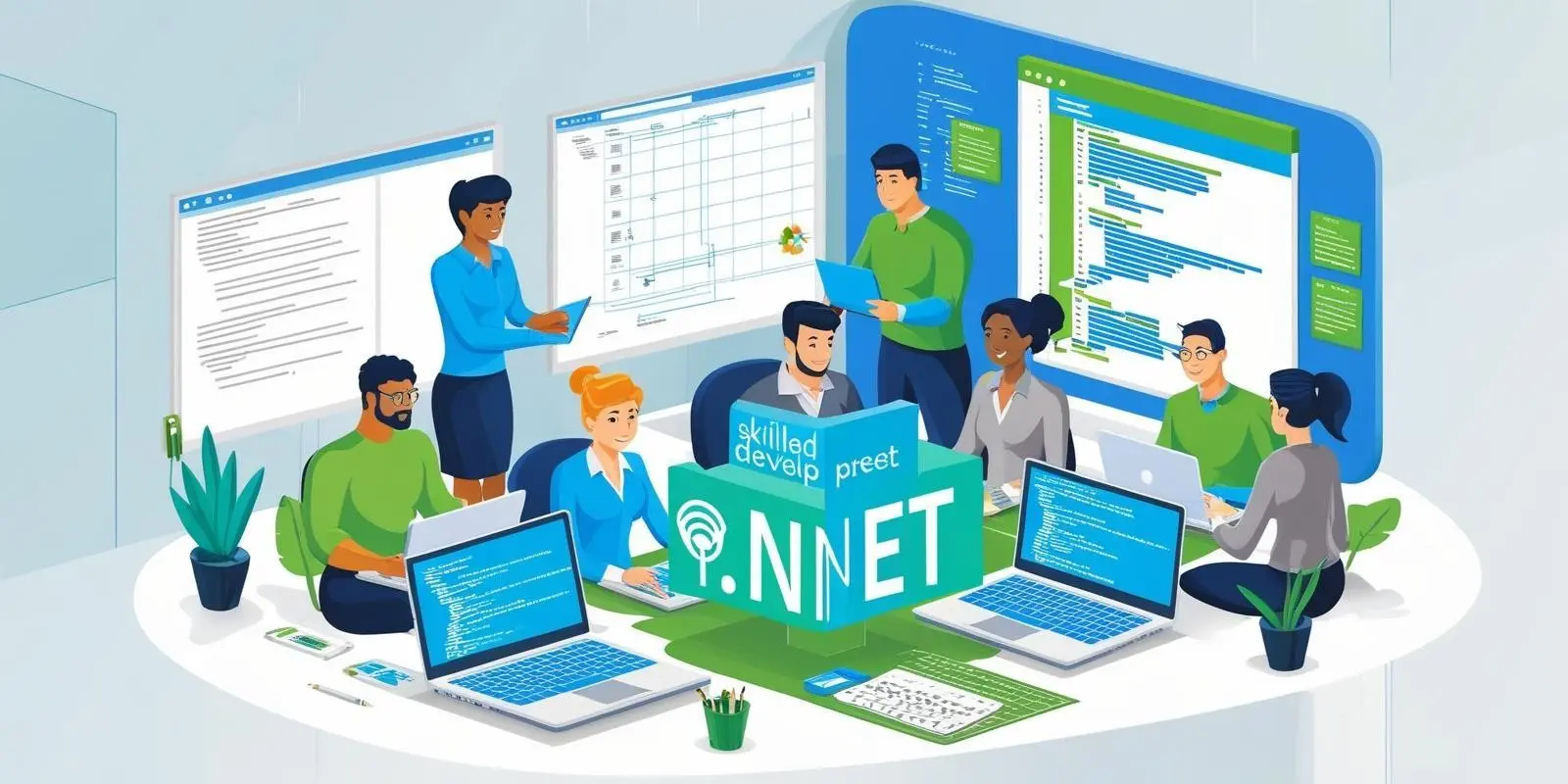
.NET Software Development enables scalable, secure, and enterprise-ready applications across platforms.
Industry Landscape & Key Challenges
.NET solution development teams face challenges such as integrating diverse Microsoft technologies, ensuring application performance, maintaining security, and delivering scalable enterprise solutions.
Many of these challenges stem from the complexity of enterprise-grade .NET applications — where front-end, back-end, databases, and APIs must work seamlessly. Developers must balance maintainability, interoperability, and performance while adhering to best practices and agile methodologies. Successful transformation requires expertise in .NET frameworks, cloud services, and DevOps integration.
Key Challenges:
- ⚙️ Integrating .NET frameworks with front-end, back-end, and third-party services.
- 🔐 Ensuring security, compliance, and data protection.
- 🚀 Maintaining high performance, scalability, and reliability.
- 📊 Monitoring application health, performance metrics, and error tracking.
- 🌍 Scaling solutions across enterprise environments and distributed teams.
Where .NET Solutions Create Value
Enterprise-Grade Scalability
.NET frameworks enable the building of large-scale applications capable of supporting millions of users. Businesses gain confidence in handling sudden surges in demand without compromising performance. This reliability reduces downtime and improves efficiency across the enterprise. Customers benefit from consistent, smooth application experiences even during peak usage.
Cross-Platform Reach
With .NET, developers can write code once and deploy it across Windows, iOS, and Android platforms. Businesses save development time and cost by reusing components. This cross-platform consistency also makes long-term maintenance easier. Customers enjoy familiar, user-friendly applications across all their devices.
Advanced Integrations
.NET easily integrates with ERP, CRM, and other enterprise systems. This makes it easier for organizations to modernize legacy environments without costly replacements. Businesses streamline workflows and maximize IT investments. Customers benefit from faster, more connected digital experiences across services.
Productivity with Tools
Microsoft’s ecosystem — including Visual Studio, Azure, and DevOps tools — makes development efficient and collaborative. Businesses reduce project delays and improve quality outcomes. Automated testing and CI/CD pipelines further accelerate releases. Customers receive better solutions in less time, with fewer errors.
Future-Proof Architecture
.NET supports both monolithic and microservices-based cloud-native architectures. This allows businesses to modernize at their own pace while remaining agile. Applications become easier to evolve alongside market and customer needs. Customers benefit from products that adapt and scale as expectations grow.
Security at Scale
With robust built-in authentication, encryption, and compliance features, .NET helps organizations secure mission-critical systems. Businesses minimize vulnerabilities and meet global security requirements. This builds trust with clients, regulators, and partners alike. Customers feel confident interacting with safe, reliable applications.
Trends Shaping DotNet Development in 2025
With the release of .NET 9, Microsoft continues to unify frameworks across web, mobile, desktop, and cloud. Developers can now build cross-platform solutions with greater performance and consistency. In 2025, .NET’s unified ecosystem will accelerate adoption among enterprises seeking efficiency.
.NET is increasingly being used to build cloud-native and serverless applications on platforms like Azure Functions and AWS Lambda. This reduces infrastructure complexity and enhances scalability. In 2025, cloud-native .NET apps will dominate enterprise digital transformation strategies.
The integration of ML.NET and Azure Cognitive Services is making it easier to embed AI into .NET applications. From predictive analytics to natural language processing, AI-powered .NET apps are becoming more common. In 2025, intelligent features will be a baseline expectation in enterprise-grade .NET solutions.
.NET developers are adopting microservices architectures with Docker and Kubernetes for modular, scalable, and maintainable systems. This shift enables faster updates and greater agility in enterprise development. In 2025, containerized .NET apps will become standard in complex software ecosystems.
With rising cyber risks, .NET development is prioritizing built-in security frameworks, identity management, and compliance-driven architectures. Developers are leveraging tools like Microsoft Identity Platform for robust protection. In 2025, security-first .NET solutions will set the bar for enterprise-grade applications.
Core Capabilities Every .NET Platform Should Provide
💻 .NET Development Capabilities
- Cross-platform application development with support for web, desktop, mobile, and cloud.
- Strong integration with Microsoft Azure, SQL Server, and enterprise ecosystems.
- High-performance APIs, microservices, and modular architectures built with .NET Core.
- Support for modern frameworks like Blazor, Entity Framework, and ASP.NET for scalability.
⚙️ Platform & Delivery Capabilities
- API-first approach with detailed SDKs and developer-friendly tooling.
- Role-based access and secure authentication aligned with enterprise security policies.
- Automated CI/CD pipelines with unit testing, code quality checks, and release approvals.
- Observability: performance profiling, logging, telemetry, and real-time error monitoring.
Security, Privacy & Compliance: Non-Negotiables for .NET Development Businesses
For .NET developers, building secure, reliable, and compliant applications is no longer just a technical requirement — it is a business necessity. Whether serving enterprises, governments, or startups, .NET applications often handle sensitive data that must be protected from breaches, misuse, and non-compliance risks. A security-first approach ensures that solutions not only perform well but also earn the trust of users and stakeholders.
- Data Protection & Encryption: Sensitive data such as financial records, healthcare information, or personal identifiers should always be encrypted both in transit and at rest. .NET provides strong libraries for implementing AES, RSA, and TLS-based encryption, ensuring that unauthorized access does not expose critical data. Prioritizing encryption builds confidence and reduces regulatory risks.
- Authentication & Role-Based Security: .NET applications should implement robust identity and access management using frameworks like ASP.NET Core Identity and integrations with OAuth2/OpenID Connect. Role-based and claims-based authorization ensures that only the right users access specific features or datasets. Combined with MFA, these controls significantly strengthen security posture.
- Compliance Alignment: Businesses using .NET must ensure compliance with regional and industry-specific frameworks such as GDPR, HIPAA, PCI DSS, or SOX depending on the domain. Built-in .NET capabilities like Data Protection APIs and logging features make it easier to align with compliance requirements. Non-compliance can be far costlier than investing in preventive governance.
- Vulnerability Management & Secure Coding: Regular static code analysis, dependency checks, and penetration testing should be part of every .NET development lifecycle. Developers should adopt secure coding practices to prevent common vulnerabilities such as SQL injection, XSS, and insecure deserialization. A proactive vulnerability management process keeps applications resilient against new attack vectors.
- Privacy by Architecture: Designing with privacy principles ensures minimal data collection, tokenization of sensitive identifiers, and anonymization for analytics. .NET developers can embed consent management features and audit logs, giving businesses transparency and users confidence. This privacy-first approach reduces liability and builds stronger trust with end customers.
Integration Across IoT, Energy, and Enterprise Systems in .NET
The .NET ecosystem offers a mature and versatile foundation for building integration-heavy solutions across IoT, energy, and enterprise environments. With strong support for APIs, cloud-native services, and enterprise-grade tooling, .NET applications can scale securely while maintaining performance. Success depends on applying patterns that ensure reliability, interoperability, and maintainability across distributed systems.
🔹 Practical Integration Patterns
- gRPC & RESTful APIs: .NET makes it easy to expose high-performance gRPC endpoints for IoT and enterprise use cases, while REST APIs remain useful for broader integrations.
- Message Brokers (Kafka, Azure Service Bus): Event-driven patterns decouple systems, enabling energy data streams and IoT telemetry to be processed asynchronously and reliably.
- Entity Framework with Hybrid Storage: Combining relational and NoSQL storage through EF Core supports both structured enterprise data and flexible IoT payloads.
- API Gateways & BFF (Backend-for-Frontend): Gateways manage authentication, routing, and transformations, while BFF layers optimize data flows for specific apps or dashboards.
🔹 Operational Considerations
- Containerized Deployments: Running .NET apps on Docker/Kubernetes ensures scalability across energy grids, IoT devices, and enterprise workloads.
- Observability with OpenTelemetry: Distributed tracing and logging enable early detection of bottlenecks in cross-system communication.
- API Lifecycle Management: Versioning and deprecation policies help keep integrations stable while allowing upgrades in enterprise APIs and IoT services.
- Security & Compliance: Features like Azure Key Vault, identity federation (OAuth2/OpenID), and field-level encryption protect sensitive energy and enterprise data.
Building a Robust DotNet Data Strategy
.NET applications rely on structured, consistent, and secure data models to ensure scalable, maintainable, and performant solutions. By combining standardized data models with flexible extensions, organizations can enable reliable APIs, analytics, and seamless integrations across Microsoft ecosystems and third-party services. This strategy supports everything from enterprise applications to cloud-enabled services and microservices architectures.
🔹 Core Principles
📌 Standards-First Approach
Adopt consistent schema design, API contracts, and .NET conventions to ensure smooth interoperability between front-end, back-end, and external services. Maintain versioning and backward compatibility.
🛠 Stable & Flexible Schemas
Separate raw database records from curated analytics and operational models. This ensures flexibility for evolving business needs while maintaining data integrity.
🔒 Privacy & Compliance Controls
Ensure secure handling of sensitive information and compliance with GDPR, HIPAA, or industry-specific regulations while supporting operational efficiency and analytics.
🔹 Analytics & Model Readiness
📊 Explicit Data Contracts
Define explicit contracts for APIs, business logic, and analytics consumption. Clear input/output definitions reduce ambiguity and ensure reliability across .NET services.
⚡ Centralized Feature Stores
Centralize operational and analytical features to support reporting, predictive models, and performance monitoring across .NET applications.
✅ Pipeline Quality Checks
Implement automated validations for schema mismatches, missing data, and anomalies to maintain reliable APIs, analytics accuracy, and application stability.
Scalability & Cloud Architecture in DotNet Development
.NET platforms must support high-performance enterprise applications, secure APIs, and complex business logic. Cloud-native, microservices-based, and multi-region architectures enable horizontal scaling, fault tolerance, and operational resilience. The platform should also integrate CI/CD pipelines, automated monitoring, and disaster recovery for uninterrupted service.
Architectural Considerations
Multi-region & Data Compliance
Deploy services across regions to improve latency, ensure high availability, and comply with local regulations for enterprise applications.
Microservices by Functional Domains
Separate services for authentication, business logic, data access, and reporting to enable independent scaling and faster deployments.
Event-Driven & Asynchronous Workflows
Use event streams, message queues, and async processing for scalable and responsive enterprise workflows.
Testing, Validation & QA for .NET Development
.NET applications require structured QA to ensure reliable functionality, maintainability, and security. Testing should cover unit, integration, and end-to-end workflows, as well as performance, scalability, and security compliance. A disciplined approach ensures enterprise-grade .NET applications perform reliably across diverse environments.
Unit & Integration Tests
Test individual classes, modules, and services independently and in combination using frameworks like xUnit or NUnit.
End-to-End Application Flows
Validate workflows across web APIs, backend services, and database interactions to ensure seamless functionality.
Performance & Load Testing
Test critical APIs and services under high load to verify responsiveness, throughput, and stability.
Security & Compliance Checks
Conduct authentication, authorization, and vulnerability scans to protect sensitive data and comply with regulations.
Cross-Platform & Browser Testing
Ensure web applications built on .NET render correctly across browsers, devices, and operating systems for consistent user experience.
Database Integrity & Backup Validation
Validate SQL Server or other database schemas, perform consistency checks, and test backup/restore procedures.
Post-Deployment Monitoring
Monitor logs, API responses, and user interactions to detect errors, bottlenecks, and performance issues early.
Implementation Playbook — a pragmatic 6-step approach
A successful DotNet Solution Development rollout requires balancing .NET frameworks, scalability, and integration with enterprise systems. The following playbook highlights practical steps that leading organizations use to transform strategy into measurable outcomes:
🔍 Phase 1 — Discovery & Planning
Assess functional requirements, system dependencies, and user workflows. Define KPIs to align DotNet development outcomes with performance, reliability, and business goals.
🏗️ Phase 2 — Architecture & Design
Design scalable .NET architectures, including front-end, back-end, and service layers; ensure secure integrations and maintainable code structures.
⚡ Phase 3 — Development & Iteration
Build incrementally using agile sprints, integrating features and services; validate functionality, performance, and interoperability continuously.
🧪 Phase 4 — Testing & Validation
Conduct unit, integration, load, and security testing to ensure .NET solutions meet quality, reliability, and compliance standards.
🔐 Phase 5 — Training & Adoption
Train development, QA, and support teams on .NET workflows, deployment, and debugging practices to ensure adoption and efficient maintenance.
📈 Phase 6 — Monitoring & Scaling
Monitor application performance, service uptime, and user metrics; scale infrastructure and services while maintaining reliability and responsiveness.
Engagement Models — flexible options for project needs
Different technology projects demand different approaches. Choosing the right engagement model ensures optimal collaboration, productivity, and alignment with business goals. Below are the most common structures used by mature teams to balance speed, cost, and control:
👨💻 Full-Time Developers
Dedicated engineers (≈40 hrs/week) aligned with project goals and timelines. Best suited for long-term development, product scaling, or continuous innovation.
⏱️ Part-Time Developers
Flexible contributors (≈15–20 hrs/week) for smaller initiatives, maintenance, or integration support. Ideal when workloads are predictable but not full-scale.
💵 Hourly Engagement
A pay-as-you-go model designed for short-term tasks, urgent fixes, or overflow capacity. Provides agility without long-term commitments.
📦 Project-Based Delivery
Fixed-scope delivery for MVPs, product modules, or compliance-driven builds. Defined timelines and measurable outcomes ensure clarity from start to finish.
Common Pitfalls to Avoid
Many DotNet Solution Development projects fail not because of technology, but due to overlooked risks in architecture, integration, and deployment workflows. Addressing these pitfalls early ensures maintainable, scalable applications with reliable performance.
Pitfalls we frequently see
- ⚠️ Over-reliance on a single DotNet framework version — risking compatibility issues and future upgrades.
- 📊 Assuming built-in components cover all needs — ignoring performance optimization, security, and scalability considerations.
- 🛠️ Neglecting proper exception handling, logging, and API design — leading to unstable or hard-to-maintain solutions.
- 📢 Skipping structured testing, CI/CD, and monitoring — delaying bug detection and deployment issues.
- 🔄 Overlooking documentation and maintainability — making future updates, integrations, and team onboarding challenging.
Case Studies — practical, measurable outcomes
.NET Enterprise App Development
Implemented modular DotNet architecture; reduced development cycle by 30% and improved system reliability by 25% within 6 months.
Data Integration & Reporting
Integrated multiple databases and reporting tools; improved data accuracy by 35% and accelerated report generation by 40%.
Secure API Development
Implemented secure REST APIs and authentication protocols; reduced unauthorized access attempts by 38% and ensured compliance with standards.
FAQ
Why should businesses choose .NET for software development?
How do you ensure quality in .NET applications?
What types of .NET solutions can you develop?
We build a wide range of .NET applications, including:
- Web applications and enterprise portals
- Desktop software using Windows Presentation Foundation (WPF) and WinForms
- Cloud-native applications with Azure integration
- Mobile applications with Xamarin and .NET MAUI
- API development and microservices architecture
- Migration and modernization of legacy systems
Whether you’re a startup building your first product or an enterprise modernizing large-scale applications, we design .NET solutions that deliver long-term business value.
How long does it take to build a .NET application?
Can .NET solutions integrate with existing business systems?
How do you ensure security in .NET applications?
Do you provide ongoing support and maintenance for .NET applications?
Conclusion
Successful .NET software development requires careful planning, integration with existing systems, and adherence to best practices for security and performance. By addressing challenges such as scalability, maintainability, and cross-platform compatibility, organizations can deliver robust applications efficiently.
Whether building enterprise applications, web services, or cloud solutions, a structured .NET development approach ensures high-quality, reliable software that supports long-term business growth and innovation.