Introduction
Artificial Intelligence (AI) and Machine Learning (ML) are at the core of digital transformation, enabling organizations to turn data into actionable insights. As industries seek greater efficiency, personalization, and automation, AI/ML adoption continues to accelerate, shaping how businesses operate and compete.
From predictive analytics and natural language processing to computer vision and intelligent automation, AI/ML technologies empower organizations to innovate at scale. These capabilities not only enhance decision-making but also unlock new opportunities for growth across multiple sectors.
Whether deploying chatbots for customer service, applying machine learning models for risk assessment, or leveraging AI to optimize supply chains, leaders can harness AI/ML to build smarter, adaptive, and future-ready enterprises.
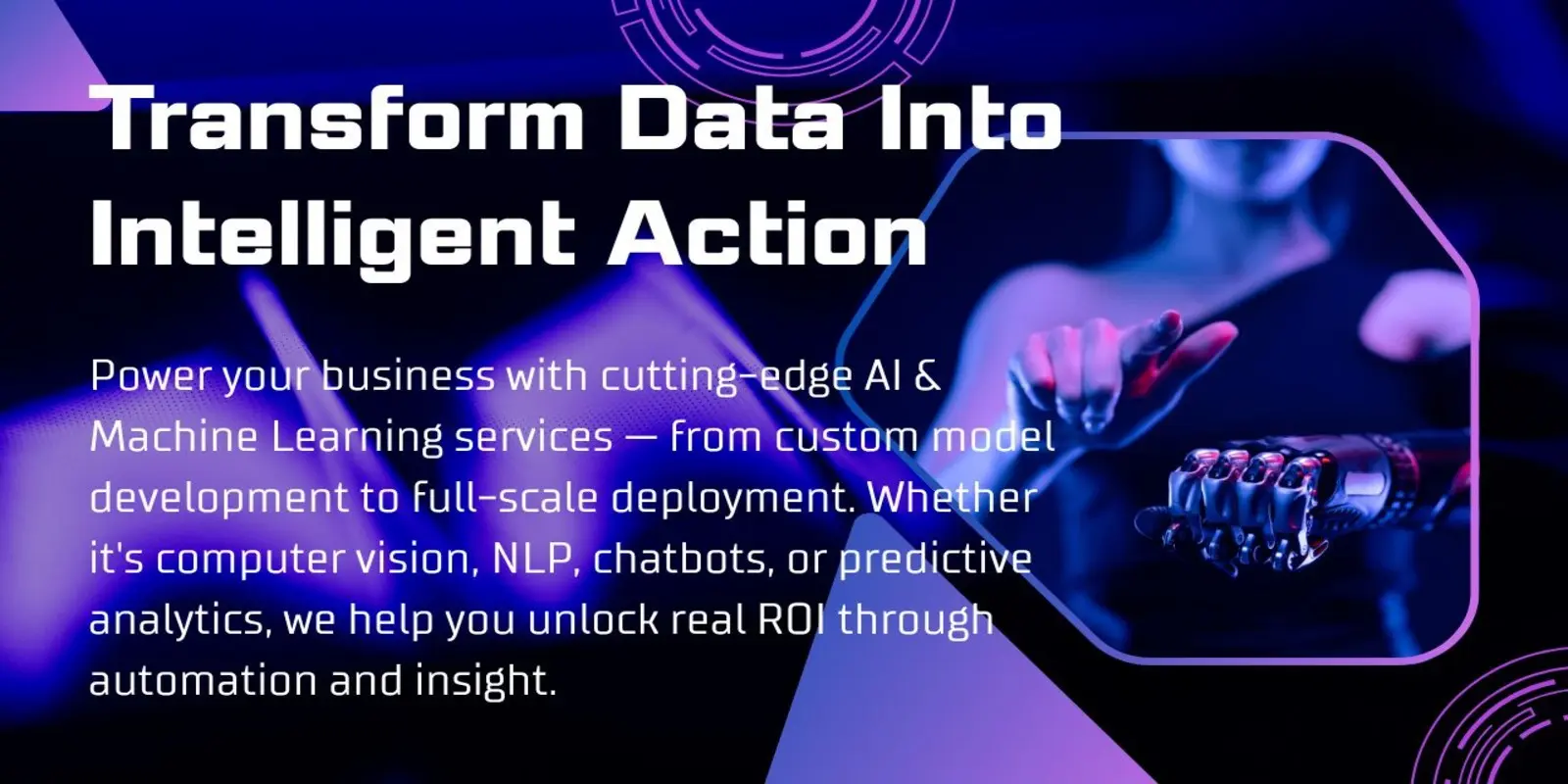
AI/ML enables automation, intelligence, and innovation across every industry.
Industry Landscape & Key Challenges
AI/ML teams face challenges such as fragmented data, model bias, interpretability, and the need to deploy scalable, reliable algorithms that deliver measurable business impact.
Many of these challenges stem from the complexity of machine learning systems — where data preprocessing, model training, and deployment pipelines must be robust and reproducible. AI/ML solutions must balance accuracy, fairness, and performance while aligning with business objectives. Successful implementation requires strong governance, ethical AI practices, and continuous monitoring.
Key Challenges:
- 📊 Integrating high-quality, diverse data for model training.
- 🔐 Ensuring compliance with ethical, regulatory, and privacy standards.
- ⚖️ Mitigating model bias and ensuring interpretability.
- 🚀 Scaling AI/ML models for production with reliability and performance.
- 🌍 Monitoring and updating models across dynamic business environments.
Where AI-Powered Solutions Create Value
Smarter Automation
AI reduces repetitive coding and testing tasks through intelligent automation. Developers focus on innovation rather than routine work. Businesses accelerate development cycles and reduce costs. Customers benefit from faster delivery of new features.
Intelligent Analytics
AI-powered development tools analyze user behavior, application performance, and code quality. Businesses gain actionable insights to optimize operations. Developers detect issues early and enhance application stability. Users experience smoother, more reliable digital journeys.
Faster Time-to-Market
By automating debugging, code suggestions, and testing, AI shortens release cycles. Organizations stay competitive in dynamic markets. Developers maintain higher productivity with fewer errors. Customers gain quicker access to improved products.
Personalized User Experiences
AI tailors apps and platforms to individual needs through recommendation systems and adaptive interfaces. Businesses enhance engagement and retention. Personalized experiences differentiate platforms in competitive industries. Customers feel valued when solutions adapt to their preferences.
Security & Reliability
AI enhances anomaly detection and strengthens app security. Automated monitoring ensures compliance with evolving standards. Businesses reduce risks while improving reliability. Users trust platforms that prioritize safety and consistency.
Ecosystem Integration
AI-powered development supports integration with cloud, IoT, and third-party services. Businesses expand functionality without rebuilding from scratch. Developers accelerate innovation through ecosystem connectivity. Customers enjoy richer, more versatile solutions.
Trends Shaping AI-Powered Development in 2025
Generative AI is transforming software engineering by assisting with design, code generation, and content creation. This accelerates development cycles while enabling more creative solutions. In 2025, generative AI will be central to building smarter, faster, and more innovative digital products.
Low-code and no-code AI tools are making advanced AI capabilities accessible to developers and business users alike. These platforms enable rapid prototyping and easier integration of AI into products. In 2025, democratized AI will empower organizations of all sizes to harness its potential.
Trust is critical when deploying AI-powered solutions in sensitive areas like healthcare, finance, and governance. Explainable AI ensures transparency in decision-making while addressing bias and ethical concerns. In 2025, ethical frameworks will be integral to successful AI-powered development.
With the rise of IoT and connected devices, AI at the edge enables instant decision-making without relying on centralized cloud servers. This improves performance, speed, and reliability for mission-critical applications. In 2025, edge AI will become a standard in industries needing real-time insights.
AI is redefining productivity by automating repetitive coding tasks, optimizing workflows, and enhancing testing. Developers can focus more on creativity and problem-solving while AI handles routine processes. In 2025, AI-enhanced development will significantly accelerate delivery while improving software quality.
Core Capabilities Every AI-Powered Development Platform Should Provide
🤖 AI & Data Capabilities
- Support for ML/AI pipelines including model training, testing, and deployment.
- Scalable data handling for structured, semi-structured, and unstructured inputs.
- Real-time inference for chatbots, recommendation engines, and predictive analytics.
- Built-in frameworks for explainable AI, bias detection, and compliance-driven AI usage.
⚙️ Platform & Delivery Capabilities
- API-first integration for embedding AI services into apps and workflows.
- Role-based access for data scientists, developers, and business stakeholders.
- Automated MLOps pipelines with model versioning, retraining, and monitoring.
- Observability: model drift detection, accuracy tracking, error logs, and usage metrics.
Security, Privacy & Compliance: Non-Negotiables for AI-Powered Development
AI-powered development introduces enormous potential for automation, personalization, and efficiency — but it also brings unique security, privacy, and compliance challenges. From protecting sensitive datasets to ensuring fairness in algorithms, businesses must take a holistic approach to governance. In 2025, organizations that prioritize ethical AI and security-first practices will stand apart in earning user trust.
- Data Protection & Encryption: AI models rely on massive datasets, often containing sensitive personal or business information. All data must be encrypted at rest and in transit using modern standards like AES-256 and TLS 1.3. Beyond encryption, teams should adopt data governance policies that define ownership, retention, and access, ensuring the AI lifecycle remains secure.
- Access Controls & Model Governance: Just like data, AI models themselves need protection. Role-based and attribute-based access controls should define who can train, deploy, or modify AI models. Immutable audit trails must capture every model change, training dataset, and deployment event. This accountability ensures explainability and compliance with industry standards.
- Bias & Vulnerability Management: AI systems are vulnerable not only to cyberattacks but also to data poisoning, adversarial inputs, and bias exploitation. Regular vulnerability scans, red-teaming exercises, and fairness testing should be mandatory in the AI development cycle. Proactive governance prevents misuse and ensures systems remain accurate, reliable, and equitable.
- Privacy-Preserving AI: Organizations must embed privacy-by-design techniques such as federated learning, differential privacy, and synthetic data generation. These approaches allow AI to learn patterns without exposing raw personal data. This balance between innovation and protection is crucial for user trust and regulatory compliance.
- Compliance & Ethical Standards: AI-powered platforms must align with emerging global frameworks like the EU AI Act, GDPR, and ISO AI governance standards. Compliance ensures legal protection, while ethical principles like transparency, fairness, and accountability strengthen brand credibility. Falling short risks fines, reputational damage, and loss of user trust.
Integration Across IoT, Energy, and Enterprise Systems in AI/ML
AI/ML solutions deliver the most value when they’re integrated seamlessly into existing IoT, energy, and enterprise ecosystems. Whether predicting equipment failures, optimizing energy grids, or personalizing enterprise workflows, machine learning models rely on smooth interoperability with diverse data sources and platforms. Building integration-ready AI/ML pipelines is essential for turning insights into action at scale.
🔹 Practical Integration Patterns
- Data Ingestion Pipelines: Connectors for IoT telemetry, smart meters, and enterprise databases enable AI models to access clean, structured inputs in real time.
- Model-as-a-Service APIs: Wrapping ML models as APIs allows enterprise and energy systems to consume predictions without needing deep ML expertise or infrastructure.
- Edge AI Deployment: Running lightweight models at the IoT edge ensures low-latency predictions for scenarios like equipment monitoring or grid balancing.
- Data Lake & Warehouse Integration: Centralizing data from IoT and enterprise workflows in warehouses or lakes ensures models are trained on consistent, governed datasets.
🔹 Operational Considerations
- Model Monitoring & Drift Detection: Automated monitoring ensures deployed models remain accurate as IoT and enterprise data evolves, preventing silent failures.
- Scalable Training & Deployment: Cloud-native ML pipelines allow distributed training and scalable inference, making integrations reliable for high-volume IoT and energy use cases.
- Explainability & Compliance: Explainable AI techniques ensure outputs can be understood and trusted by regulators and business users, particularly in energy and enterprise contexts.
- Automated Retraining Workflows: Integration with CI/CD ensures models are retrained on new data and redeployed seamlessly, keeping predictions fresh and relevant.
Building a Robust AI/ML Data Strategy
AI and ML rely on high-quality, consistent, and well-governed data to train models, validate predictions, and deliver actionable insights. A robust data strategy combines standardized datasets, feature stores, and monitoring pipelines to ensure reproducibility and reliability. This approach supports model development, deployment, and continuous improvement across diverse AI applications.
🔹 Core Principles
📌 Standardized Datasets
Use consistent data schemas, labeling standards, and preprocessing pipelines to ensure training datasets are reliable and reproducible across experiments.
🛠 Stable & Flexible Feature Stores
Maintain centralized feature stores that allow experimentation while ensuring backward compatibility and traceability for production models.
🔒 Privacy & Governance
Apply data anonymization, encryption, and compliance-aware pipelines to protect sensitive data while adhering to GDPR, HIPAA, or other regulatory requirements.
🔹 Analytics & Model Readiness
📊 Model Metrics & Dashboards
Centralize model performance metrics, drift monitoring, and evaluation scores to provide visibility into model reliability and accuracy.
⚡ Automated ML Pipelines
Automate training, validation, and deployment pipelines to reduce human error, maintain consistency, and accelerate iteration cycles.
✅ Continuous Monitoring & Feedback
Monitor model predictions, data drift, and feature importance continuously to ensure performance, fairness, and compliance over time.
Scalability & Cloud Architecture in AI-Powered Development
AI platforms must handle large-scale data ingestion, model training, and inference workloads efficiently. Cloud-native, multi-region deployments, and microservices architectures ensure horizontal scaling, GPU/TPU resource optimization, and high availability. Platforms should also support versioned models, reproducible pipelines, and automated monitoring for performance and reliability.
Architectural Considerations
Multi-region & Compute Resource Management
Distribute workloads across regions and leverage GPU/TPU clusters to optimize performance, reduce latency, and ensure high availability for AI pipelines.
Microservices for ML Components
Separate services for data ingestion, feature engineering, model training, inference, and analytics to allow independent scaling and faster iteration.
Event-Driven & Pipeline Orchestration
Use event streams for triggering model retraining, inference workflows, and monitoring alerts to maintain accuracy and responsiveness.
Testing, Validation & QA for AI-Powered Development
AI systems require rigorous QA and validation due to their impact on decisions and predictions. Testing ensures models are accurate, fair, interpretable, and resilient against errors. Structured validation reduces risks, builds trust, and ensures AI solutions align with business objectives and ethical standards.
Data Quality Testing
Validate input datasets for completeness, correctness, and consistency to prevent downstream model errors.
Model Performance Validation
Test models against benchmarks for accuracy, precision, recall, and other domain-specific metrics before deployment.
Bias & Fairness Testing
Evaluate AI outputs for bias and unfair treatment to ensure equitable outcomes across demographics and scenarios.
Interpretability & Explainability
Ensure model decisions are interpretable and explainable to stakeholders, regulators, and end-users.
Stress & Edge Case Testing
Test models under extreme or unexpected conditions to ensure robustness and prevent failures in production.
Continuous Monitoring & Drift Detection
Monitor deployed models for data or concept drift, updating pipelines as necessary to maintain accuracy over time.
Regulatory & Ethical Compliance
Ensure AI models adhere to relevant regulations, standards, and ethical guidelines for responsible AI deployment.
Implementation Playbook — a pragmatic 6-step approach
A successful AI/ML rollout requires balancing model accuracy, scalability, and ethical considerations. The following playbook highlights practical steps that leading organizations use to transform strategy into measurable outcomes:
🔍 Phase 1 — Discovery & Planning
Assess available data, problem statements, and business impact areas. Define KPIs to align AI/ML outcomes with accuracy, efficiency, and strategic goals.
🏗️ Phase 2 — Architecture & Design
Design scalable, secure AI/ML pipelines, model deployment architectures, and monitoring frameworks while ensuring explainability and compliance.
⚡ Phase 3 — Development & Iteration
Train and iterate models incrementally using pilot datasets; validate performance and fine-tune hyperparameters to achieve target outcomes.
🧪 Phase 4 — Testing & Validation
Conduct model validation, bias assessment, and scenario testing to ensure robustness, fairness, and alignment with business requirements.
🔐 Phase 5 — Training & Adoption
Train business users, data scientists, and operational teams on AI/ML outputs, dashboards, and decision-support systems to maximize adoption.
📈 Phase 6 — Monitoring & Scaling
Continuously monitor model performance, drift, and operational impact; scale AI/ML solutions across processes while maintaining reliability and ethical standards.
Engagement Models — flexible options for project needs
Different technology projects demand different approaches. Choosing the right engagement model ensures optimal collaboration, productivity, and alignment with business goals. Below are the most common structures used by mature teams to balance speed, cost, and control:
👨💻 Full-Time Developers
Dedicated engineers (≈40 hrs/week) aligned with project goals and timelines. Best suited for long-term development, product scaling, or continuous innovation.
⏱️ Part-Time Developers
Flexible contributors (≈15–20 hrs/week) for smaller initiatives, maintenance, or integration support. Ideal when workloads are predictable but not full-scale.
💵 Hourly Engagement
A pay-as-you-go model designed for short-term tasks, urgent fixes, or overflow capacity. Provides agility without long-term commitments.
📦 Project-Based Delivery
Fixed-scope delivery for MVPs, product modules, or compliance-driven builds. Defined timelines and measurable outcomes ensure clarity from start to finish.
Common Pitfalls to Avoid
Many AI/ML initiatives fail not because of model complexity, but due to overlooked risks in data quality, deployment, and ethical considerations. Addressing these pitfalls early ensures robust models, ethical outcomes, and sustainable adoption.
Pitfalls we frequently see
- ⚠️ Over-reliance on a single dataset — risking bias, imbalance, or lack of generalization.
- 📊 Assuming data is preprocessed and clean — ignoring anomalies, missing values, or noise that affect model performance.
- 🤖 Neglecting explainability — deploying models that stakeholders cannot interpret or trust.
- 📢 Skipping monitoring, validation, and retraining — letting models drift or degrade unnoticed.
- 🔄 Overlooking ethical, privacy, and regulatory considerations — risking biased outcomes, privacy breaches, or non-compliance.
Case Studies — practical, measurable outcomes
Predictive Maintenance AI
Developed machine learning models for equipment failure prediction; reduced downtime by 28% and maintenance costs by 20% within 6 months.
Natural Language Processing Chatbot
AI-driven conversational agent increased customer query resolution by 35% and reduced response time by 40%.
Demand Forecasting Models
Advanced ML algorithms improved forecasting accuracy by 30% and optimized resource allocation by 22%.
FAQ
Why do businesses invest in AI-powered solutions?
How do you ensure ethical and secure use of AI?
What types of AI-powered solutions can you develop?
We build a wide range of AI-driven solutions, including:
- Predictive analytics and forecasting tools
- Natural Language Processing (NLP) applications like chatbots and virtual assistants
- Computer vision solutions for image and video analysis
- Recommendation engines for personalization
- AI-powered process automation and RPA
- Intelligent dashboards and decision-support systems
Whether you’re a startup exploring AI for customer engagement or an enterprise implementing large-scale automation, we tailor AI solutions to drive measurable business value.
How long does it take to develop AI-powered applications?
Can AI be integrated with existing software and workflows?
How do you ensure accuracy and scalability in AI solutions?
Do you provide ongoing support and model maintenance?
Conclusion
Harnessing the potential of AI and Machine Learning requires more than technical expertise—it demands clear objectives, high-quality data, and a focus on ethical implementation. By addressing challenges such as bias, scalability, and integration, organizations can unlock transformative value from AI/ML initiatives.
Whether building predictive models, deploying intelligent automation, or integrating AI into customer experiences, a strategic AI/ML roadmap ensures that solutions deliver measurable insights, operational efficiency, and sustainable innovation.